

- Joined
- Mar 7, 2019
- Messages
- 104,029
- Reaction score
- 35,477
- Points
- 138
- Age
- 29
No big text crawl in this post. Just a really creepy and morbid thread of athletes who died on camera, including Silver King and Perro Aguayo Jr.


Buddhafield is a new religious movement in the United States. It began in the 1980s in Hollywood, and continues in Hawaii today, often recruiting through yoga studios. The group has been described as a cult by some former members.
The leader of Buddhafield is a man previously known as Michel, Andreas, The Teacher, or Reyji, born Jaime Gomez.[1][2] He was once known to wear nothing but swim briefs and eyeliner.[3] He is featured in the documentary film Holy Hell directed by Will Allen. He is also featured on the Netflix series How to Become a Cult Leader (season 1 episode 3 entitled "Reform Their Minds").
Gomez voiced his anxieties to his then-follower Will Allen after the Waco siege.[5] Allen pinpoints this as the moment when Gomez's paranoia began.[5] Gomez left his followers for six months to find a new location for the group.[5] Gomez also began to undergo increasing amounts of plastic surgery around this time, as well as recommending his female followers undergo similar procedures.[5][6] Gomez also attempted to get followers to report on each others' perceived transgressions.[2] He kept one follower from seeing her father before he died, and encouraged another to get an abortion, claiming religious reasons.[6]
Many allegations have been made against Jaime Gomez, most notably sexual abuse of his male followers.[3] His victims have said that they had their confessions in their weekly hypnotherapy sessions used against them.[5][6] Gomez also used the AIDS crisis to instill fear in his gay male followers to frighten them into staying.[6] The group has been described as a cult by some former members.[6]

From April 9–11, 1947, a significant tornado outbreak produced catastrophic effects over portions of the southern Great Plains, in the contiguous United States. The outbreak generated at least 12, and possibly 17 or more, tornadoes, many of which were significant. On Wednesday, April 9, a series of related tornadoes spawned by a single supercell, dubbed the Glazier–Higgins–Woodward tornadoes, swept through the U.S. states of Texas, Oklahoma, and Kansas. Most of the damage and nearly all of the deaths are still blamed on one large tornado, known as the Glazier–Higgins–Woodward tornado, that traveled 98 mi (158 km) from Texas to Oklahoma, beginning over the South Plains. This event, up to nearly 2 mi (3.2 km) in width, was often compared to the Tri-State tornado, because it was originally thought to have left a 198-to-221-mile-long (319 to 356 km) path, was similarly large and intense for much of its path, and was also retroactively rated F5 on the modern-day Fujita scale, but it is now believed to have been part of a 125-to-170-mile-long (201 to 274 km) family of nine or 10 tornadoes.[nb 1]
Cleanup in the region was made more difficult because of cold and snow that followed the tornado. Four-year-old Joan Gay Croft and her sister Jerri were among refugees taking shelter in a basement hallway of the Woodward hospital. As officials sent the injured to different hospitals in the area, two men took Joan away, saying they were taking her to Oklahoma City. She was never seen again. Over the years, several women have come forth saying they suspect they might be Joan, although none of the claims have been verified. She is likely deceased.
The Billups Neon Crossing Signal was an experimental grade crossing signal installed at a dangerous Illinois Central crossing on Mississippi Highway 7 (now Mississippi Highway 332) in Grenada, Mississippi.
The signal was installed in the mid-1930s by inventor Alonzo Billups over growing concern due to numerous collisions at the crossing involving trains and motor vehicles. Unlike anything likely seen around the country at the time, the Billups signal was a large gantry spanning the highway and was likely the first such use of a gantry-style crossing of the type now in relatively common use. Upon approach of a train, a giant alternating blue and red neon sign lit up with the words "STOP - DEATH - STOP" beneath a skull and crossbones. Flashing neon arrows indicated the direction that oncoming trains were traveling and an air raid siren (civil defense siren) in lieu of bells provided aural warning. As a backup, standard railway flashers were mounted below the neon sign. The signal was known locally as the "Skull and Crossbones."[1]
The onset of World War II brought about a scarcity of neon, which, when coupled with maintenance problems with the signal (often manifesting themselves in the siren sounding continuously until a crew arrived to stop it), meant that no further signals were produced. The prototype later had standard railway crossing signals installed alongside it until it was removed entirely around 1970, in which the standard signals replaced it entirely.[1]
In the 2020s, Lionel has made models of the Billups Railroad Crossing for O-gauge toy train layouts.[2]

Daniele Alves Lopes was a 16-year-old Brazilian who jumped to her death from the Centro Comercial Presidente building in São Paulo's central business district.[1] The suicide was filmed by a Brazilian news show, Aqui Agora, and shown on SBT. This broadcast led to a surge in ratings and a national conversation about the sensationalized, violent, and amoral nature of the show.[2]
On July 5, 1993, Daniele Lopes, despondent from a recent romantic break-up, climbed out on a seventh-story parapet of an office building where she worked as a receptionist. While she was contemplating her fate, police and a news crew arrived and started filming. The events were filmed until after the girl jumped, but the scene was cut before she reached the ground.[3][4]
When the unedited footage was shown on Brazilian national television, it caused a spike in ratings. Lopes's youth and broken heart may have romanticized and contributed to the interest in the incident.[3]
The Brazilian psychiatrist Jacob Pinheiro Goldberg was a prominent critical voice of the broadcast, stating it may cause a societal desensitization effect,[5] and psychoanalyst Jurandir Freire Costa referred to the media as vultures. Other communication experts were also critical.[3]
In 1994, the Alves Lopes family reached a R$ 1.05 million settlement with SBT for moral damage.[6]


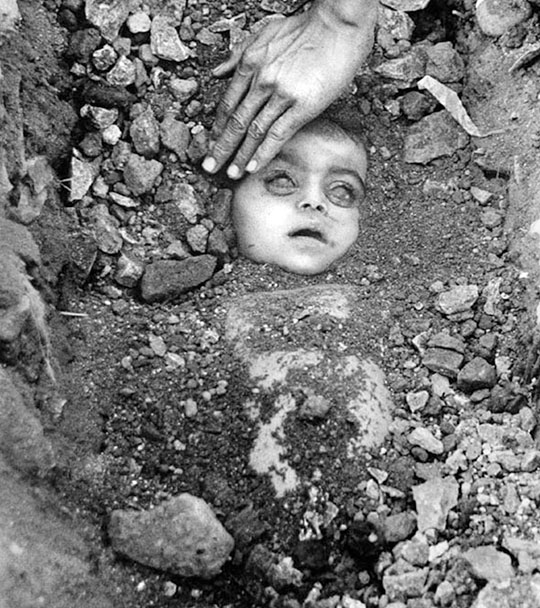
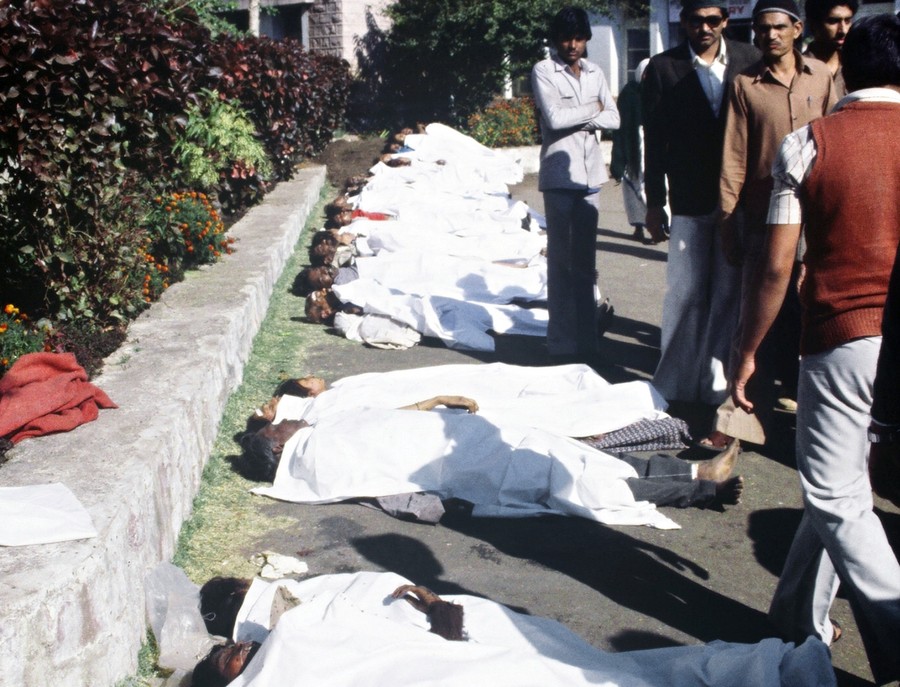
On 3 December 1984, over 500,000 people in the vicinity of the Union Carbide India Limited pesticide plant in Bhopal, Madhya Pradesh, India, were exposed to the highly toxic gas methyl isocyanate, in what is considered the world's worst industrial disaster.[3] A government affidavit in 2006 stated that the leak caused approximately 558,125 injuries, including 38,478 temporary partial injuries and 3,900 severely and permanently disabling injuries.[4] Estimates vary on the death toll, with the official number of immediate deaths being 2,259.[5] Others estimate that 8,000 died within two weeks of the incident occurring, and another 8,000 or more died from gas-related diseases.[6] In 1989, Union Carbide Corporation (UCC) of the United States paid $470 million (equivalent to $1.03 billion in 2024) to settle litigation stemming from the disaster.[7]
In 1976, two local trade unions complained of pollution within the plant.[18][19] In 1981, a worker was accidentally splashed with phosgene as he was carrying out a maintenance job of the plant's pipes. In a panic, he removed his gas mask and inhaled a large amount of toxic phosgene gas, leading to his death 72 hours later.[18][19] Following these events, journalist Rajkumar Keswani began investigating and published his findings in Bhopal's local paper Rapat, in which he urged "Wake up, people of Bhopal, you are on the edge of a volcano."[20][21]
In January 1982, a phosgene leak exposed 24 workers, all of whom were admitted to a hospital. None of the workers had been ordered to wear protective equipment. One month later in February 1982, an MIC leak affected 18 workers. In August 1982, a chemical engineer came into contact with liquid MIC, resulting in burns over 30% of his body. In October 1982, there was another MIC leak. In attempting to stop the leak, the MIC supervisor suffered severe chemical burns and two other workers were severely exposed to the gases.[18] During 1983 and 1984, there were leaks of MIC, chlorine, monomethylamine, phosgene, and carbon tetrachloride, sometimes in combination.[19][22]
By early December 1984, most of the plant's MIC related safety systems were malfunctioning and many valves and lines were in poor condition. In addition, several vent gas scrubbers had been out of service, as well as the steam boiler intended to clean the pipes.[6] During the late evening hours of 2 December 1984, water was believed to have entered tank E610 via a side pipe during attempts to unclog it. The tank still contained the 42 tons of MIC that had been there since late October.[6] The introduction of water into the tank resulted in a runaway exothermic reaction, which was accelerated by contaminants, high ambient temperatures, and various other factors such as the presence of iron from corroding non-stainless steel pipelines.[6] [...]
When the tea break concluded at 12:40 a.m., the reaction in tank E610 escalated to a critical state at an alarming speed within five minutes. Temperatures in the tank were off the scale beyond 25 °C (77 °F), and the pressure in the tank was indicated at 280 kilopascals (40 psi). One employee witnessed a concrete slab above tank E610 crack as the emergency relief valve burst open, and pressure in the tank continued to increase to 380 kilopascals (55 psi), despite atmospheric venting of toxic MIC gas having begun.[25] Direct atmospheric venting should have been prevented or at least partially mitigated by at least three safety devices which were malfunctioning, not in use, insufficiently sized, or otherwise rendered inoperable:[26][27]
About 30 tonnes of MIC escaped from the tank into the atmosphere in 45 to 60 minutes.[5] This would increase to 40 tonnes within two hours.[29] The gases were blown in a southeast direction over Bhopal.[6][30]
- A refrigeration system meant to cool tanks containing liquid MIC had been shut down in January 1982 and the freon had been removed in June 1984. Since the MIC storage system assumed refrigeration, its high temperature alarm, set to sound at 11 °C (52 °F) had long since been disconnected, and tank storage temperatures ranged between 15 °C (59 °F) and 40 °C (104 °F)[28]
- A flare tower to burn the MIC gas as it escaped, which had had a connecting pipe removed for maintenance, was improperly sized to neutralise a leak of the size produced by tank E610.
- A vent gas scrubber which had been deactivated at the time and was in 'standby' mode, and similarly had insufficient caustic soda and power to safely stop a leak of the magnitude produced.
The initial effects of exposure were coughing, severe eye irritation, a feeling of suffocation, burning in the respiratory tract, blepharospasm, breathlessness, stomach pains, and vomiting. People alerted by these symptoms fled from the plant. Those who ran inhaled more than those in vehicles. Owing to their height, children and other residents of shorter stature inhaled higher concentrations, as methyl isocyanate gas is approximately twice as dense as air and in an open environment has a tendency to fall toward the ground.[34]
Thousands of people had died by the following morning. Primary causes of deaths were choking, reflexogenic circulatory collapse, and pulmonary oedema. Findings during autopsies revealed changes not only in the lungs but also cerebral oedema, tubular necrosis of the kidneys, fatty degeneration of the liver, and necrotising enteritis.[35][6] The individuals who did not die suffered from cancer, blindness, loss of livelihood, and financial strain.[36]
Formal statements were issued that air, water, vegetation, and foodstuffs were safe, but people were warned not to consume fish. The number of children exposed to the gases was at least 200,000.[6] Within weeks, the State Government established a number of hospitals, clinics, and mobile units in the gas-affected area to treat the victims. S. Ravi Rajan (Prof. Environmental Studies, U.C. Santa Cruz) outlines the financially driven undertones of the company's actions. UCC had participated in decades of previous instances of "environmental negligence in every part of the world", directing its "responsibility… to its shareholders", and numerous dealings with local and international political and economic powers.[36] The company's response to the Bhopal accident was what Rajan describes as a "campaign of erasure",[36] meaning the transfer of liability and responsibility of the cause of the gas leak, the event itself, and the aftermath. Rajan then argues that this type of response is to be expected "according to [the] established cultural practice"[36] within large corporations such as UCC. Since UCC absolved itself from the situation, the Indian government was the next institution that was looked to by the people of Bhopal, but they had also not prepared for such an event. The government's attempts at short and long-term plans failed in successfully aiding victims and instead "created an ecology of opportunity… built largely at the expense of the victims."[36]
Chemicals abandoned at the plant continue[needs update] to leak and pollute the groundwater.[69][102][103][104] Whether the chemicals pose a health hazard is disputed.[105] Contamination at the site and surrounding area was not caused by the gas leakage. The area around the plant was used as a dumping ground for hazardous chemicals and by 1982 water wells in the vicinity of the UCIL factory had to be abandoned.[6] UCC states that "after the incident, UCIL began clean-up work at the site under the direction of Indian central and state government authorities". The work was continued from 1994 by Eveready Industries India, Limited (EIIL) who was UCIL's successor. In 1998, the Madhya Pradesh State Government, which owned and had been leasing the property to EIIL, cancelled the lease, took over the facility and assumed all accountability for the site, including the completion of any remediation.[41][86]
UCC's laboratory tests in 1989 revealed that soil and water samples collected from near the factory were toxic to fish. Twenty-one areas inside the plant were reported to be highly polluted. In 1991 the municipal authorities declared that water from over 100 wells was hazardous for health if used for drinking.[6] In 1994 it was reported that 21% of the factory premises were seriously contaminated with chemicals.[59][106][107] Beginning in 1999, studies made by Greenpeace and others from soil, groundwater, well water and vegetables from the residential areas around UCIL and from the UCIL factory area show contamination with a range of toxic heavy metals and chemical compounds. Substances found, according to the reports, are 1-Naphthol, naphthalene, Sevin, tarry residues, organochlorines, mercury, chromium, copper, nickel, lead, hexachlorethane, hexachlorobutadiene, pesticide HCH, volatile organic compounds and halo-organics.[106][107][108][109] Many of these contaminants were also found in breast milk of women living near the area.[110] Soil tests were conducted by Greenpeace in 1999. One sample (IT9012) from "sediment collected from drain under former Sevin plant" showed mercury levels to be at "20,000 and 6 million times" higher than expected levels. Organochlorine compounds at elevated levels were also present in groundwater collected from (sample IT9040) a 4.4 metres (14 ft) depth "bore-hole within the former UCIL site". This sample was obtained from a source posted with a warning sign which read "Water unfit for consumption".[111] Chemicals that have been linked to various forms of cancer were also discovered, as well as trichloroethylene, known to impair foetal development, at 50 times above safety limits specified by the U.S. Environmental Protection Agency (EPA).[110] In 2002, an inquiry by Fact-Finding Mission on Bhopal found a number of toxins, including mercury, lead, 1,3,5 trichlorobenzene, dichloromethane and chloroform, in nursing women's breast milk.
A 2004 BBC Radio 5 broadcast reported the site is contaminated with toxic chemicals including hexachlorocyclohexane and mercury, held in open containers or loose on the ground.[112] A drinking water sample from a well near the site had levels of contamination 500 times higher than the maximum limits recommended by the World Health Organization.[112] In 2009, the Centre for Science and Environment, a Delhi-based pollution monitoring lab, released test results showing pesticide groundwater contamination up to three kilometres from the factory.[113] Also in 2009, the BBC took a water sample from a frequently used hand pump, located just north of the plant. The sample, tested in UK, was found to contain 1,000 times the World Health Organization's recommended maximum amount of carbon tetrachloride,[114] which causes liver and kidney damage, and is "possibly carcinogenic to humans".[115]
In 2010, a British photojournalist ventured into the abandoned UCIL factory to investigate allegations of abandoned, leaking toxins. He was hospitalized in Bhopal for a week after he was exposed to chemicals. Doctors at the Sambhavna Clinic treated him with oxygen, painkillers and anti-inflammatories following a severe respiratory reaction to toxic dust inside the factory.[116][117]
In October 2011, the Institute of Environmental Management and Assessment published an article and video by two British environmental scientists, showing the current state of the plant, landfill and solar evaporation ponds and calling for renewed international efforts to provide the necessary skills to clean up the site and contaminated groundwater.[118]
On December 3, 2024, the 40th anniversary of the incident, Madhya Pradesh High Court ruled that the site must be cleaned up in the next month. Despite protests against a plan to incinerate the hazardous waste in Pithampur,[119] on January 1, 2025, an overnight caravan of a dozen semi trucks with police escort, a quick-response team, fire engines and ambulances[120][121] delivered 377 tons of waste to Pithampur Industrial Area for incineration.[122] Despite promises that the several hundred tons of toxic waste will be processed safely and responsibly,[123] protests continued in Pithampur.[122]









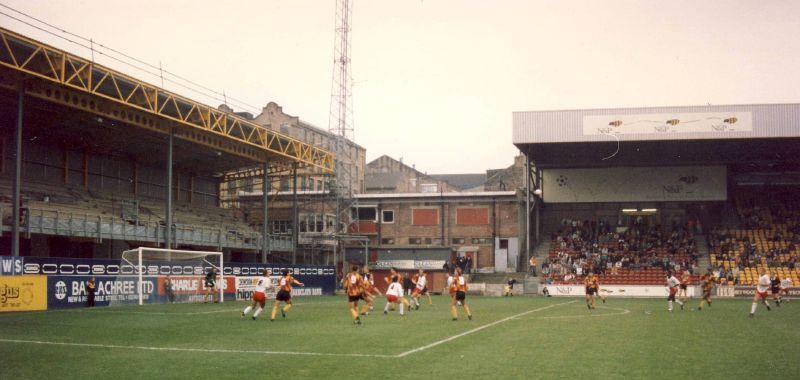
The Bradford City stadium fire occurred during a Football League Third Division match on Saturday 11 May 1985 at the Valley Parade stadium in Bradford, West Yorkshire, England, killing 56 spectators and injuring at least 265. The stadium was known for its antiquated design and facilities, which included the wooden roof of the main stand. Previous warnings had also been given about a major build-up of litter in the cavity below the stand. The stand had been officially condemned and was due to be replaced with a steel structure after the season ended.
The match between Bradford City and Lincoln City, the final game of the season, had started in a celebratory atmosphere with Bradford receiving the Third Division championship trophy. At 3:40 pm, the television commentator John Helm remarked upon a small fire in the main stand; in less than four minutes, with the windy conditions, the fire had engulfed the whole stand. In the panic that ensued, fleeing crowds escaped on to the pitch but others at the back of the stand tried to break down locked exit doors to escape. Many were burnt to death at the turnstile gates, which had been locked after the match had begun. There were many cases of heroism, with more than 50 people later receiving police awards or commendations for bravery.
At 3:44 pm, five minutes before half-time, the first sign of a fire – a glowing light – was noticed three rows from the back of block G,[10][15] as reported by the television commentator John Helm. Helm later described the start of the fire in an interview to the Daily Express newspaper:
One witness saw paper or debris on fire, about nine inches (230 mm) below the floor boards.[10] The stand seats did not have staircases; this had allowed a large accumulation of rubbish and paper waste in the cavity space under the stand. Spectators later spoke of initially feeling their feet becoming warmer; one of them ran to the back of the stand for a fire extinguisher but found none. A police officer shouted to a colleague for an extinguisher, but his call was misheard and instead the fire brigade were radioed.[10] The call was timed at 3:43 pm.[11][A] man over from Australia visiting his son got two tickets to the game. He lit a cigarette and when it was coming to an end he put it down on to the floorboard and tried to put his foot on it to put it out. It slipped through a hole in the floorboard. A minute later he saw a small plume of smoke so he poured his coffee on it and so did his son. It seemed to put it out. But a minute or so later there was suddenly a bigger whoosh of smoke so they went to get a steward. By the time they got back, the whole thing had taken off.[16]
The fire escalated very rapidly, and flames became visible; police started to evacuate the stand. As the blaze spread, the wooden stands and roof – covered with layers of highly flammable bituminous roofing felt – quickly went ablaze. Burning timbers and molten materials fell from the roof onto the crowd and seating below, and dense black smoke enveloped a passageway behind the stand, where many spectators were trying to escape.[10] One eyewitness, Geoffrey Mitchell, told the BBC: "It spread like a flash. I've never seen anything like it. The smoke was choking. You could hardly breathe."[15] As spectators began to cascade over the wall separating the stand from the pitch, the linesman on that side of the pitch informed referee Norman Glover, who stopped the game with three minutes remaining before half-time.[13] It took 270 seconds for the entire stand to burn down.[17]
People who had escaped the fire then tried to assist their fellow supporters. Police officers also assisted in the rescue attempts. One man clambered over burning seats to help a fan,[18] as did player John Hawley,[14] and one officer led fans to an exit, only to find it shut and had to turn around.[10] Bradford City's coach Terry Yorath, whose family was in the stand,[19] ran onto the pitch to help evacuate people. Another player went into the office space to ensure there was nobody there.[19] One fan put his jumper over a fellow supporter's head to extinguish flames.[11] Those who escaped were taken out of the ground to neighbouring homes and a pub, where a television screened World of Sport, which broadcast video recorded of the fire just an hour after it was filmed.
The fire brigade arrived at the ground four minutes after they were initially alerted. However, the fire had consumed the stand entirely by that point and they were faced with huge flames and very dense smoke. As many supporters still required rescue from the stand, they were unable to immediately start fighting the source of the fire.
The fire destroyed the main stand completely and left only burned seats, lamps and metal fences remaining. Some of those who died were still sitting upright in their seats, covered by remnants of tarpaulin that had fallen from the roof. Police worked until 4 am the next morning, under lighting, to remove all the bodies. Within a few hours of the blaze starting, it was established that 56 people had been killed, many as a result of smoke inhalation, although some of them had survived until reaching hospital.[11]

Gernot Reinstadler (24 August 1970 – 19 January 1991) was an Austrian ski racer. He was regarded as among the most promising young talents of the Austrian downhill team of the early 1990s. He died in 1991 after a crash.
During training for the Lauberhorn race, while entering the finish S (German: Ziel-S), Reinstadler lost control and crashed into safety nets at full speed, where one of his skis became trapped. Reinstadler suffered a significant pelvic fracture and severe internal injuries and bleeding. He died later the same night at a hospital in Interlaken after undergoing several blood transfusions.[1]
Following Reinstadler's death, the 1991 Lauberhorn race was cancelled. As a result of the incident, safety measures were improved — the holes in safety nets were made smaller so that ski tips could no longer become so easily entangled in them upon impact.[2]

